Getting Started with DeskDirector
DeskDirector Portals
Browser Support
What is the DeskDirector Admin Portal?
What is the DeskDirector Tech Portal
What is the DeskDirector Client Portal?
Desktop Portal
Managing Your Account
Admin Essentials
DeskDirector Features Overview
Logging in to DeskDirector
User Profiles & Profile Pictures
Managing Tickets with DeskDirector
Office Hours
How Searching Works
Embedding Help Page Media
Get started with the DeskDirector Power Automate Connector
Features
Portal Customization
Forms
Service Catalogue
Communication
Email Connectors
Notifications
Email Notifications
Actionable Messages for Emails
Real-Time Chats
Email Template Engine
Surveys
Broadcasts
Generative AI
Setting up AI Service Providers
Microsoft Foundry for DeskDirector
Knowledge Bases for AI Assistants
Custom Tools for AI Assistants
DeskDirector with Generative AI
AI Assistants in DeskDirector
Ticket Summary for TECH Portal
Advanced
Login & Authentication
Dashboard
Accounts
Contacts
Contact Groups
Approvals
Tags
Custom Domains
Task Lists
File Storage
The Learning Center
Portal Deep Linking
Auditing & Analytics
Microsoft Power Automate
Actions
Solutions
Featured Solution: Teams Ticket Discussion
Power Automate Template Gallery
Featured Solution: Ticket Briefing
Power Automate Administration
DeskDirector Power Platform Connector Reference
Power Automate Connector - Setting up your first flow
Microsoft Teams App
Introducing the DeskDirector for Microsoft Team App
Installing the Microsoft Teams App (Client Mode)
Installing the Microsoft Teams App (TECH Mode)
Setting up Tags for Teams Discussions (TECH Portal)
Branding the DeskDirector Teams App
DeskDirector Teams App Notifications
Contact Groups Integration with Microsoft Teams
Setting up Content Security Policy (CSP)
Advanced topic: Setting up Tech & Client Mode in the same tenancy
Integrating Microsoft Teams with DeskDirector Tech Portal
Smart Alerts for TECH Users
Integrations
Glossary
Security
Troubleshooting
Troubleshooting via Web Developer Tools
Desktop Portal - Common Issues
Contact & Service Agent Impersonation
Approvals - Common Issues
Microsoft Teams App - Common Issues
Email & Email Delivery - Common Issues
Login & Authentication - Common Issues
DeskDirector Desktop App - Installation Issues
Permissions & Access - Common Issues
Contact DeskDirector Support
Troubleshooting DeskDirector Connection Issues
Table of Contents
- All Categories
- Features
- Contacts
Contacts
 Updated
by Niamh Ferns
Updated
by Niamh Ferns
Contacts
You can easily manage contacts you handle from the DeskDirector Admin Portal.
You can access this page from Client Portal > Contacts in the DeskDirector Admin Portal. You will see a page that looks like this, which shows all the contacts under your instance:
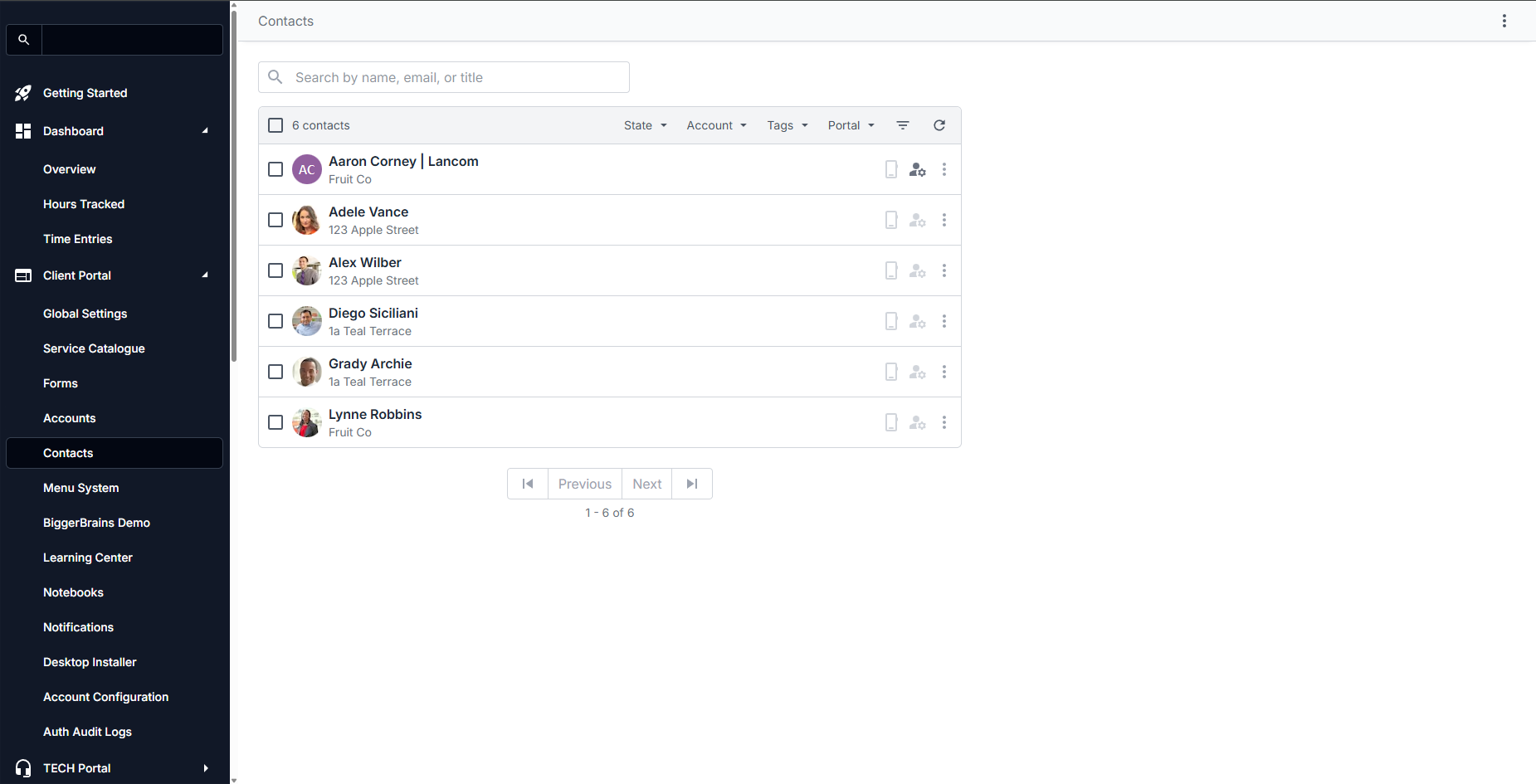
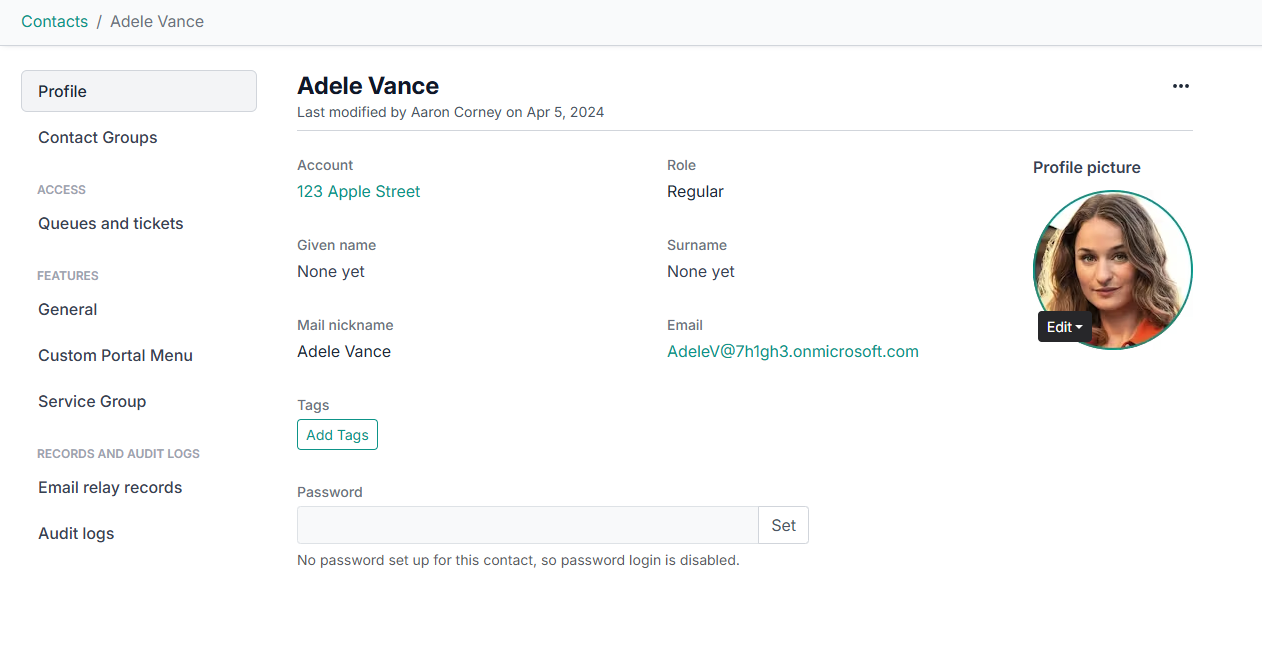
From this page, you can select which contacts you want to manage by clicking on the contact name. This brings you to the configuration page for that specific contact, which looks like this:
Filtering Contacts
As the number of contacts you handle grows, managing which ones have specific configurations can get overwhelming. To make it easier for you to manage this, DeskDirector uses tags and configuration filters. These appear in the contact list view for you to use:
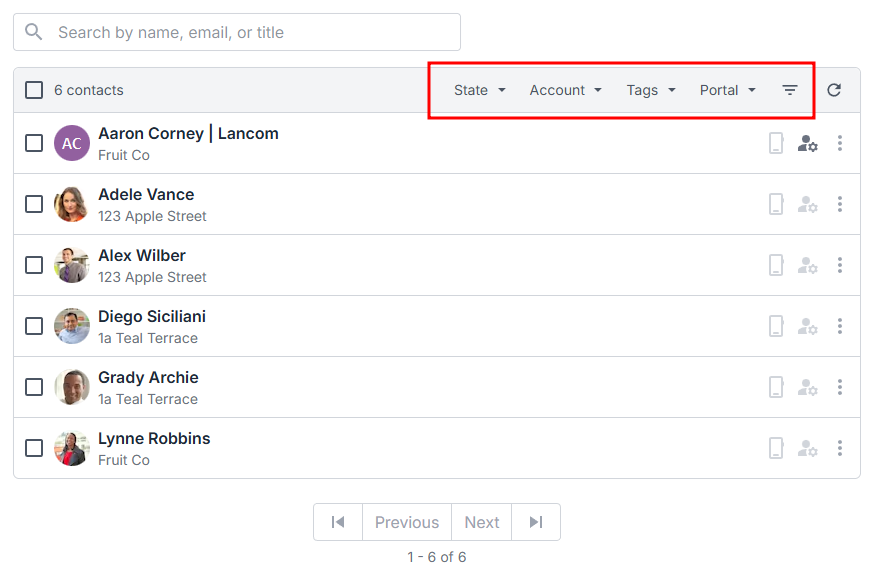
Profile
This page will show the contact's details like their name, phone number, email address, company and the site/branch they are assigned to. You should also see the contact's profile picture. You can also add contact-specific tags.
From the profile, you can also impersonate the contact or set/reset the contact's password if they or you want standard username and password login for the user to the client portal.
Contact Groups
Here, you see a list of Contact Groups that this contact is in. You can also go straight to the contact group from this section to make updates if needed.
Access
Queues and tickets
Here, you can make contact-specific changes to ticket permissions. These are the most specific form of permission configuration and will override both global and account-level settings (see cascading override).
Features
General
Similar to the global and account-level permissions, but any changes at the contact level override both global and account-level permissions (see cascading override).
Custom Portal Menu
On this page, you can select which menu a contact is shown in. This setting respects cascading override and will default to the account's menu if none is configured.
Service Group
This allows you to set which Service Group is assigned to the contact and will override the account and global level settings (see cascading override).